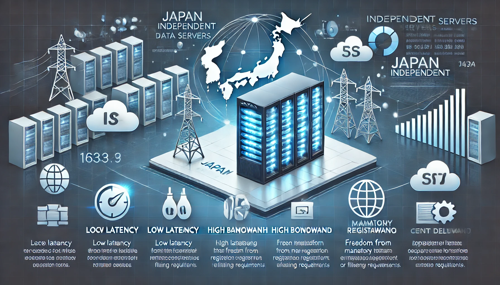
in the enterprise cloud reference framework, how to build a japanese vps and achieve multi-node disaster recovery capabilities is a key issue. this article provides operational technical routes and precautions from aspects such as network, node deployment, data synchronization and switching strategies to help enterprises establish a highly available cloud architecture in japan to meet business continuity and compliance requirements.
japanese vps selection and network layout
when choosing a japanese vps , priority should be given to node location, backbone network access and asn interconnection quality. in the enterprise cloud reference, it is also necessary to evaluate whether the computer room is close to the main backbone nodes, the peak bandwidth performance, and the delay and packet loss rate of the public network exit to ensure the stability of cross-border access and business experience. at the same time, it is necessary to confirm the service provider's sla commitment, ip resource management, ipv4/ipv6 support, and whether direct connection and dedicated line access options are provided.
multi-node disaster recovery architecture design
when building a multi-node disaster recovery architecture, it is recommended to adopt a hybrid active-standby and active-active strategy, distribute core services on at least two vps nodes in japan, and retain off-site backups at domestic or other overseas nodes. realize traffic distribution and automatic failover through load balancing, health check and gslb, reducing the risk of single point failure and improving overall availability.
data synchronization and consistency strategy
data synchronization is the core of disaster recovery. you can choose asynchronous, semi-synchronous or synchronous replication strategies based on business characteristics. latency-sensitive trading systems prioritize semi-synchronous or synchronous replication, and combine incremental backups with log transfers to reduce data loss. database and file storage should have recovery point objectives (rpo) and recovery time objectives (rto) to guide design.
network redundancy and acceleration optimization
network redundancy includes multiple bgp/direct lines and dns redundant configurations. using cdn and intelligent routing can improve the cross-border access experience. establish link monitoring, delay detection and packet loss alarm mechanisms, and accelerate business links through sd-wan or dedicated lines when necessary to ensure session maintenance and connection stability during node switching.
automated operation and maintenance and disaster recovery drills
automated deployment and operation and maintenance can significantly improve disaster recovery response speed. rapid node orchestration is achieved through iac tools, and configuration consistency is achieved in combination with the ci/cd pipeline. regularly conduct full and partial fault drills to verify the switching process, data integrity and business availability, and form a closed-loop problem feedback and optimization mechanism.
security and compliance considerations
when deploying a vps in japan, you need to pay attention to data sovereignty and privacy protection requirements. implement host and network protection, intrusion detection, log auditing and access control. use encrypted transmission and storage of sensitive data, and develop emergency response and filing procedures to ensure that corporate compliance and regulatory needs can still be met during disaster recovery switching.
cost control and observability
disaster recovery capability is not better when it is stronger. cost-availability trade-offs should be made based on business value. reduce long-term costs through elastic expansion and contraction, on-demand scheduling and cold backup strategies. improve monitoring, indicator collection and visual alarms, use slo/sla to quantify service levels, and support cost decision-making and operation and maintenance priority setting.
implementation steps and timetable recommendations
the implementation recommendations are promoted in phases: demand assessment, network and node deployment, data synchronization solution implementation, switching and recovery strategy testing, monitoring and security reinforcement. set clear acceptance criteria and rollback plans at each stage to gradually increase online traffic and avoid risks caused by one-time large-scale switching.
frequently asked questions and risk warnings
common risks include cross-border network fluctuations, regional failures, configuration inconsistencies and misconfigured permissions. attention should be paid to switching delays, backup verification failures, and log inconsistencies caused by dns caching. establish a cross-department communication mechanism and emergency contact list to reduce fault response time and improve drill effectiveness.
summary and suggestions
enterprises moving to the cloud refer to how to build a japanese vps to achieve multi-node disaster recovery capabilities. they should formulate hierarchical disaster recovery strategies based on business criticality. combining network redundancy, data synchronization, automated operation and maintenance and compliance control, and through regular drills and monitoring optimization, a highly available, observable and cost-controllable cross-border disaster recovery system will be gradually realized. it is recommended to start with key business pilots and then gradually expand to full deployment.
- Latest articles
- In-depth analysis of the pricing of AWS cloud servers in the U.S., along with hidden costs and cost-saving strategies
- Comparison Guide for Japanese Cloud Server Accelerators for Gaming and Video Services
- Best Practices for Accelerating Long-Video Distribution Using Cambodia’s Video Cloud Servers in Collaboration with CDN
- Examples of operational scenarios. What does “Korean original IP” mean? Cases of social media and traffic control
- Technical analysis: Is Cherry VPS a Japanese-based IP address, and what is its impact on latency?
- Architect’s perspective: Which data center in Hong Kong has better server stability and performance? Analysis
- List of Qualifications and Registration Procedures to Be Aware Of Before Buying Cloud Servers in Thailand
- Solutions for cross-border players to stably connect to Taiwan servers of flight simulation games
- Engineering Case Study: Communication Line Layout in Server Rooms – High-Density Fiber Optic Cabling Solutions in Germany
- Best Practices for Network Performance Monitoring and Alerting in Alibaba Cloud’s CN2 Networks in Singapore and Hong Kong
- Popular tags
-
comparative evaluation of the protection effects of japanese high-defense cloud servers from different manufacturers
professionally compares and evaluates the protection effects of japanese high-defense cloud servers from different manufacturers, and provides test methods and selection suggestions from the dimensions of protection capabilities, network architecture, detection response, waf and operation and maintenance support, which is suitable for seo optimization and corporate decision-making reference. -
explore the efficiency and flexibility of japan dynamic vps
explore the efficiency and flexibility of japan dynamic vps and learn how it can improve website performance and user experience. -

Advantages and choice skills for renting a Japanese website cloud server
This article introduces the advantages and selection techniques of renting a Japanese website cloud server to help you make smarter decisions.